
When I first discovered the Chemnitzer in the summer of 2024, I was not only introduced to a strange and fascinating instrument – I also became aware of this relative of mine, Walter Mazcka, who first bought and played it.
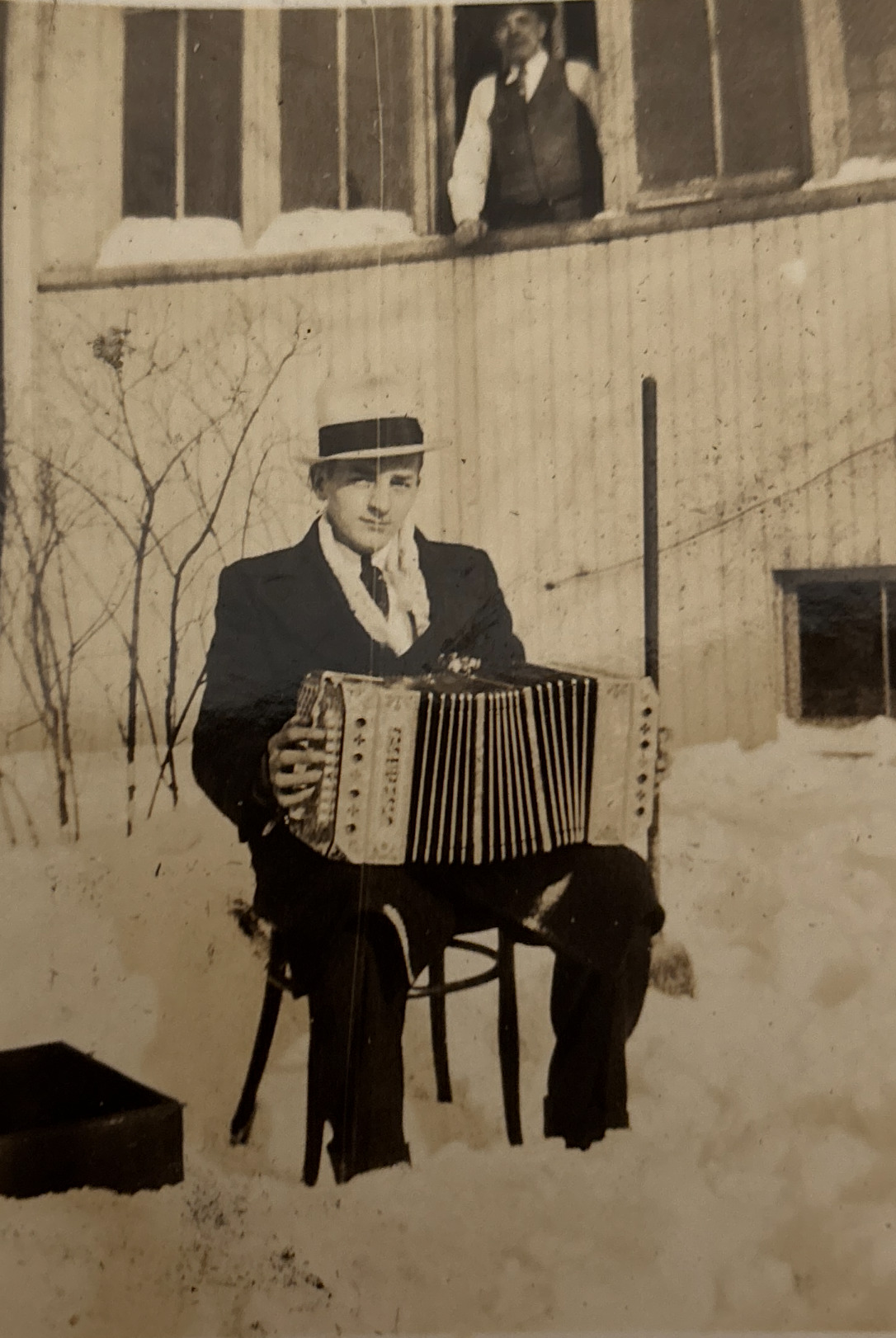
This October I was able to sit down with my grandmother, Bernie, and talk about her father and his concertina.
“He was born in Chicago in I think 1916. He was one of five children,” she tells me as we sit down. We’re at the house where she lives with my grandad Wayne in Heathesville, VA, and there’s a strong rain pattering outside the kitchen windows. “He met my mother, fell in love. She was from a family of five also. They wound up having five children – I’m the second of their five.”
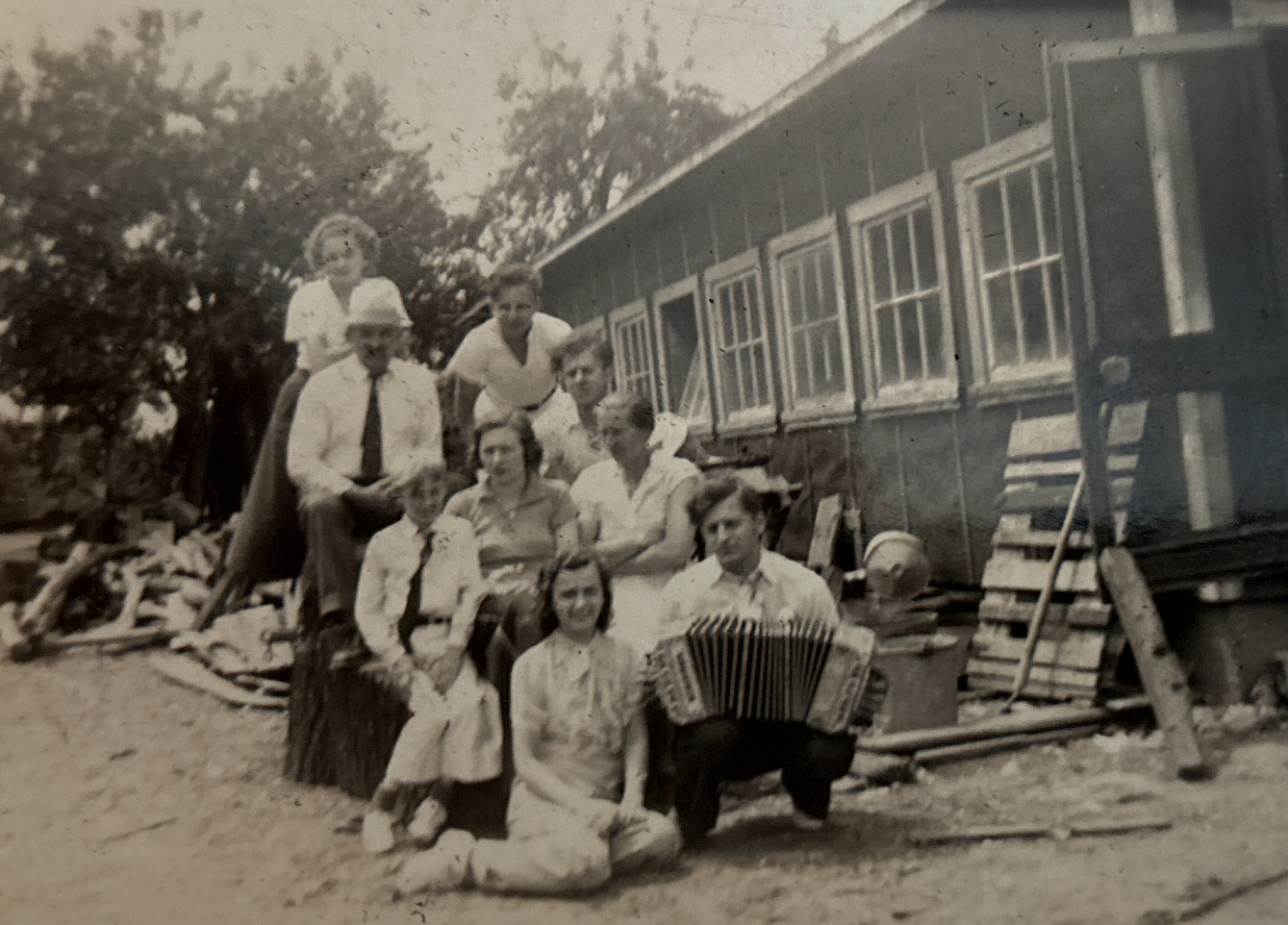
We look at a grainy black-and-white photo of Walter with his family on vacation at a lake, dated 1931. Walter is in the front with his wife Estelle, and he’s holding his concertina. “That’s his youngest brother Stanley,” Bernie tells me. “That’s his mother … her name was Angeline. And this is his father … Valentine, I think in Polish it was Walenty. When they came across, I think they just named him Valentine. And this is his twin sister Stella.” His brother Chester and his sister Mary are also in the photo. “[Mary] was the oldest, and then I think Walter,” Bernie says.
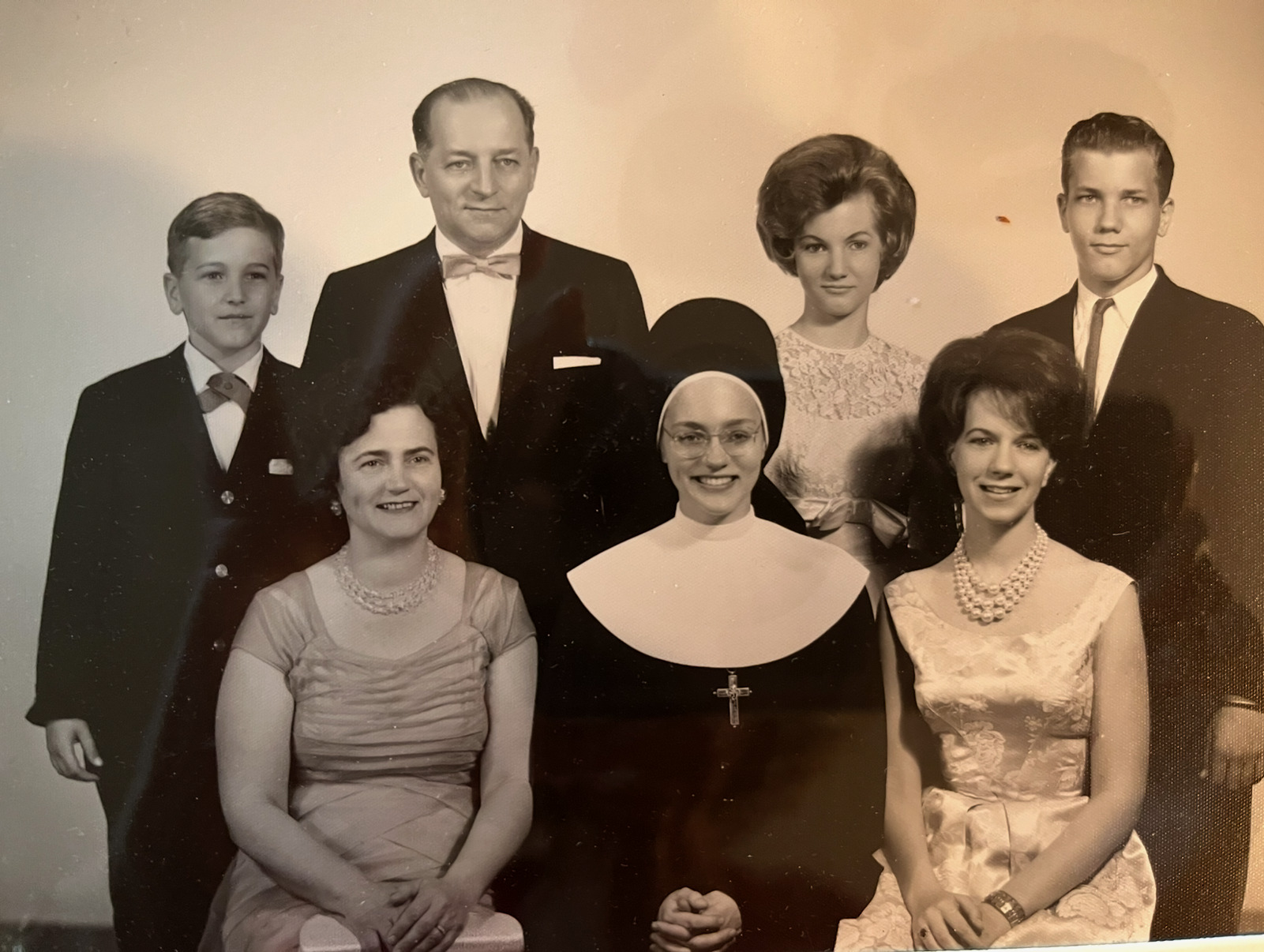
If you’re wondering, Maczka is pronounced “mat-ska.” It’s a Polish name – Walter and his whole family were Polish. His parents Valentine and Angeline were both children when their families immigrated, as best Bernie can recall. After Walter married Estelle, they lived in a neighborhood by Newport Avenue in the Northwest side the city. That’s where Bernie grew up. “[It was] quite heavily Polish,” she recalls.
The parents sent Bernie to a Polish school downtown, where she studied Polish language and learned traditional dances while in costume. “They wanted us to learn the Polish culture,” she says. Polka music was a piece of this culture too. Many of the school’s dances were set to polka, and Bernie says, “[Polka] was my mom and dad’s favorite.” She remembers jukeboxes and radio stations dedicated to the genre. But she tells me her generation was more interested in other music: “What we now call the oldies,” she says – 50s and 60s pop. “The Beatles, for one,” she recalls clearly.
Bernie told me that her father rarely played the concertina when she knew him. “We’d have to ask,” she says. “Generally it was around Christmas time when we could get him to play.”
“Do you know when he got it?” I ask Bernie.
“I don’t,” she replies. “I’m assuming high school.” That would have been around 1930. Despite his later reticence to perform, he was an avid player in earlier years: “He was in a band and he played, I guess, quite often on weekends. So my mom would go listen. But as far as we can remember, he was not in a band after the war, or at least after Melanie was born anyway.”
Bernie tells me he worked for most of his life at a factory called American Spring and Wire, and that he worked his way up from a simple cleaning job to a department manager. Halfway through his career, he shipped out for war. “He was in World War II and actually didn’t get to meet his firstborn daughter until after he came back from the war,” she says. “He came home I think in 1943.” She says he served in the Army Air Corps in Saipan, a small Pacific island.
“Did he ever talk about his experiences in the war?” I ask.
“No, he didn’t. And my sisters and brothers and I regret the fact that we didn’t question him more. He was a reserved man. And so he didn’t volunteer a whole lot of information.”
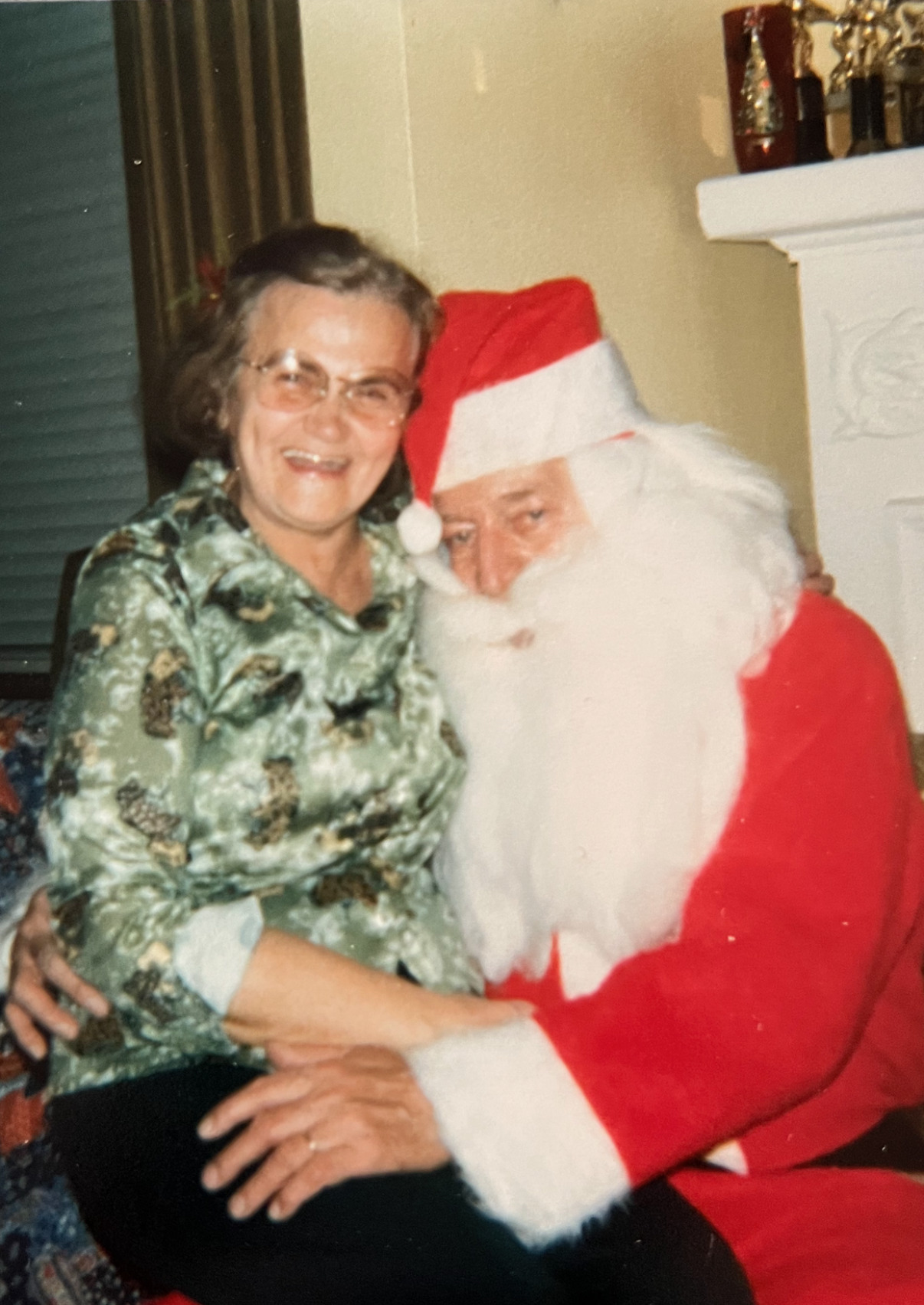
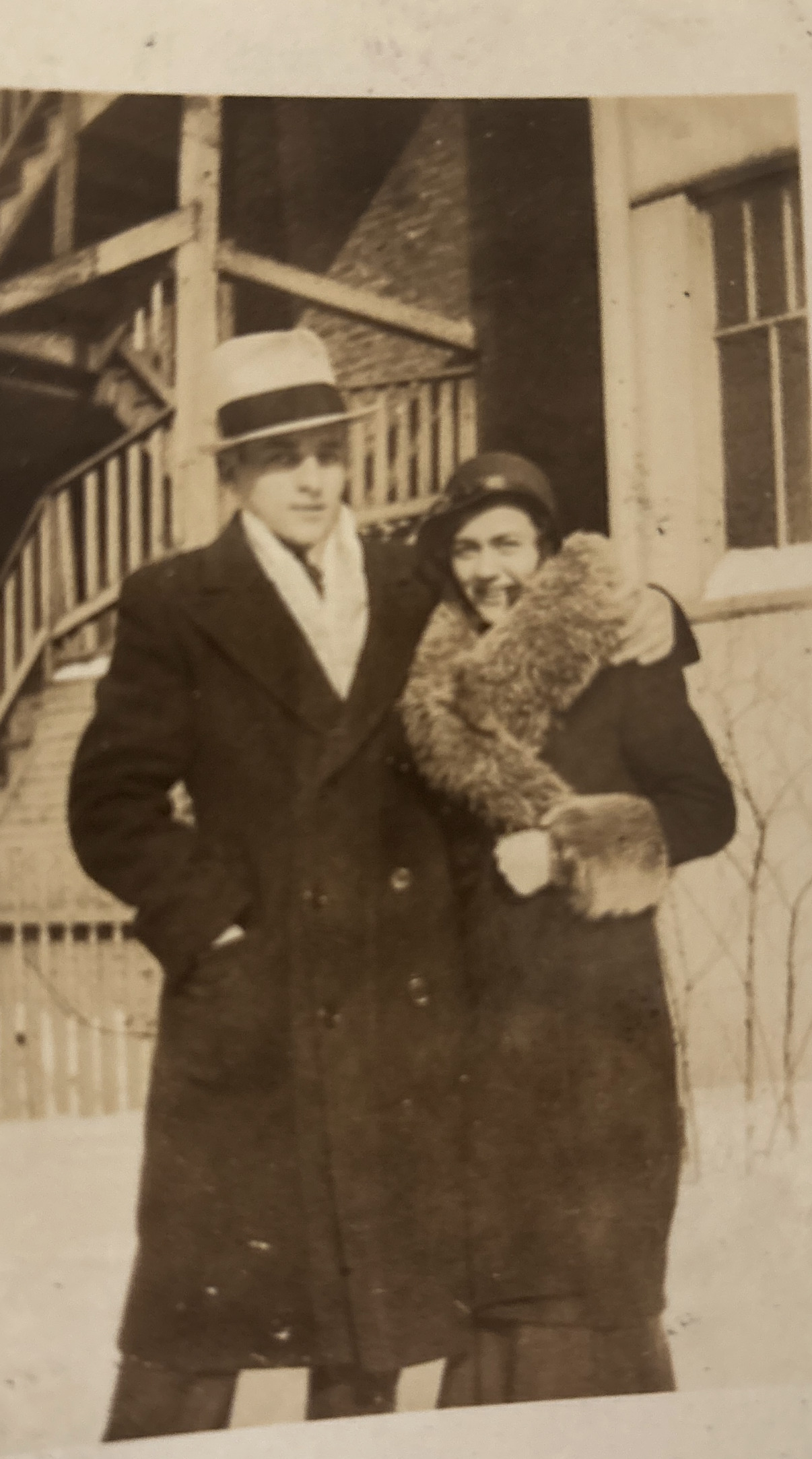
But despite his quiet nature, Walter had a fun side. We look at a picture of him dressed up as Santa, hugging Estelle. “He did it mostly for the grandkids,” says Nana. “He rented this wonderful Santa Claus outfit and the kids loved it. And they obviously didn’t know it was him until finally he took his beard off. But he was a great Santa… handed out candy, presents.” My father, Nana’s son Bill, still recalls Santa Dzia-dzia very fondly! (Dzia-dzia, pronounced “ja-ja,” is Polish for grandpa.)
My grandparents Bernie and Wayne traveled around the world for Wayne’s career in the Navy. But Walter and Estelle stayed in Chicago their whole lives. “They were both born in Chicago and never ventured,” she says. “On Sundays, we would take what they called our Sunday drive and we’d either drive to one of the lakes or drive down to Lake Michigan. As much driving as he had to do back and forth, he enjoyed the Sunday drives.”
Walter’s car of choice? Always a Buick, according to Bernie. “I don’t think he owned any other car except a Buick. Every three years he would replace it with a new Buick,” she tells me, rolling her eyes.
Walter passed away in April 1981, and Estelle passed six years later in October 1987. Bernie remembers her mother as a strong woman, “extremely neat and clean,” and a magnificent craftsperson. She recalls her father as quiet but kind, always ready to shuttle her around town or play a game of bowling.
There’s a rich history in this Chemnitzer – it’s touched many lives! I’m very thankful for my Nana and for this chance to learn more about our family.